The Berimbau and the Instruments of Capoeira
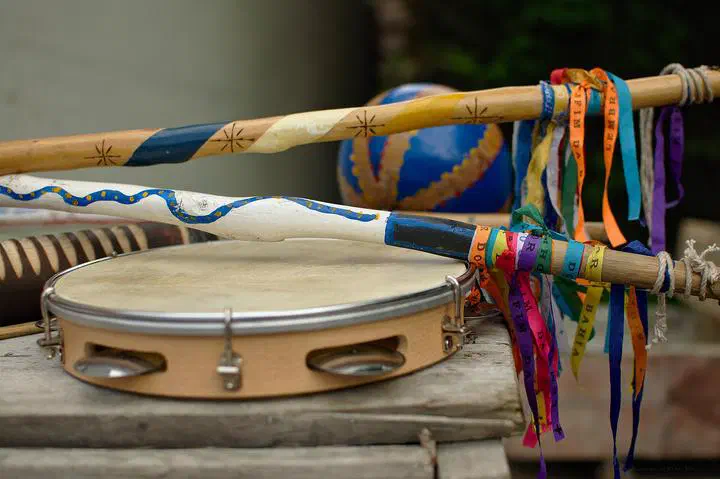 Berimbaus and a pandeiro ready for a Capoeira Angola roda. Photo: virtual comandante, CC BY-SA 2.0
In capoeira there’s no game without music. Every roda is led by a small orchestra called the bateria, and at its head is the berimbau, a musical bow with a single steel string. The music sets the speed of the game, tells the players which kind of game to play and holds the energy of the whole circle. Here’s what each instrument is, how it works and why capoeiristas learn to play them all.
The berimbau: the soul of the roda
The berimbau looks simple: a wooden bow, a wire and a gourd. It is descended from musical bows that enslaved Africans brought to Brazil, especially from Central Africa, where similar bows are still played today. In 19th-century Brazil, travellers described bows like it under names such as urucungo. Over time the berimbau became so closely linked to capoeira that today it’s hard to imagine one without the other.
A berimbau is made of:
- Verga: a bow of flexible wood, traditionally biriba, about 1.5 metres long.
- Arame: a steel wire, often taken from the inside of an old car tyre, stretched between the two ends of the bow.
- Cabaça: a hollow, dried gourd tied near the bottom of the bow, which works as a sound box.
- Baqueta: a thin wooden stick used to strike the wire.
- Dobrão: a coin or smooth stone, pressed against the wire to change the note.
- Caxixi: a small woven basket rattle with seeds inside, held in the same hand as the stick.
The player holds the berimbau in one hand, with the gourd’s opening against the belly. Moving the gourd towards and away from the body makes the famous “wah-wah” sound. With the stone off the wire you get a low, open note; pressed hard against it, a higher note; touching it lightly, a buzzing sound. These three sounds, plus the caxixi, are enough to play every rhythm in capoeira.
Gunga, médio and viola
Many rodas use three berimbaus, each with a different size of gourd:
- Gunga (or berra-boi): the biggest gourd and the lowest sound. It is usually played by the most experienced person in the roda, who leads the music and the roda itself.
- Médio: the middle voice, which plays the base rhythm opposite the gunga.
- Viola: the smallest gourd and the highest sound. It improvises and decorates the rhythm.
Together they sound like a single conversation in three voices.
The toques: rhythms that tell you how to play
Each rhythm on the berimbau is called a toque, and each toque asks for a different kind of game. A few of the best known:
- Angola: slow and deep, for a low, strategic, close game.
- São Bento Pequeno: a medium rhythm that often accompanies the Angola game.
- São Bento Grande: fast, for a quick, upright and dynamic game.
- Benguela: a slower, flowing rhythm for a smooth, close game with few high kicks.
- Iúna: a melodic toque, traditionally reserved for advanced students and masters.
- Cavalaria: according to tradition it was played to warn capoeiristas that the mounted police were coming, at the time when capoeira was banned.
The toques don’t mean exactly the same thing in every group or style, which is one more reason to learn them from your teachers.
The pandeiro
The pandeiro is a frame drum with metal jingles (platinelas) around the rim, similar to a tambourine. It is used all over Brazilian music, from samba to capoeira. In the roda it fills in the rhythm of the berimbaus with a steady beat. Many rodas have one or two pandeiros.
The atabaque
The atabaque is a tall wooden drum played with the hands. The same drum is used in the ceremonies of Afro-Brazilian religions such as Candomblé, and in capoeira it gives the roda a deep, powerful pulse. It’s played carefully, supporting the berimbaus rather than covering them. Read more about this link in Candomblé and Capoeira.
The agogô and the reco-reco
Many rodas, especially in Capoeira Angola, also include:
- Agogô: two metal bells of different pitch, struck with a stick.
- Reco-reco: a scraper, often made of bamboo with notches cut into it, played by rubbing a stick along it.
How a roda’s music works
When a roda begins, the berimbaus start, then the other instruments join in. Players crouch at the foot of the berimbau (pé do berimbau) and wait for the signal to start the game. The songs follow a pattern: a solo song (ladainha), then a call to praise (chula or louvação), and then the call-and-response songs (corridos) that the whole circle answers while the game goes on.
Not every style uses the same bateria:
- Capoeira Angola rodas often have three berimbaus, two pandeiros, an atabaque, an agogô and a reco-reco.
- Mestre Bimba’s Capoeira Regional used just one berimbau and two pandeiros.
- Contemporary groups vary, but three berimbaus, a pandeiro and an atabaque are common.
You can read more about these differences in Capoeira Angola, Regional and Contemporânea.
Watch and listen
These videos are in Portuguese, but the music speaks for itself:
- 30 toques de berimbau: Mestre Koioty plays thirty berimbau rhythms, one after another.
- Toques de berimbau: gunga, médio, viola: what each of the three berimbaus should play (Saber Capoeira).
- Bateria da capoeira: atabaque and pandeiro: how the drum and the pandeiro accompany the main toques (Mestre Koioty).
Learn to play in Berlin
In capoeira, music isn’t something you leave to others. Every capoeirista learns to play the berimbau, the pandeiro and the atabaque, and to sing. Our own group anthem, Himno Simplesmente Capoeira, names toques like São Bento, Benguela and Iúna.
New to capoeira? Start with What is Capoeira?
At Simplesmente Capoeira Berlin, instruments and songs are part of training. You don’t need to know any music to start: come to a class in Schöneberg, Kreuzberg or Mitte, and your first month is free.