Who was Besouro Mangangá?
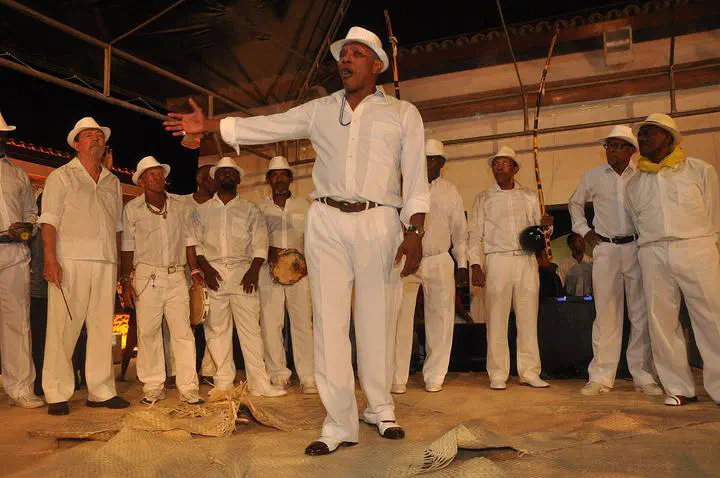 A roda of veteran mestres in Bahia, 2012. Photo: Rita Barreto / Setur Bahia, CC BY-SA 2.0
Besouro Mangangá is the most legendary figure in the history of capoeira. Born Manoel Henrique Pereira in Santo Amaro, Bahia, he lived at the beginning of the 20th century, when capoeira was a crime in Brazil. He became famous for standing up to the police and to rich landowners, for defending poor workers, and for a body that, people said, no bullet or knife could harm. He died young, in 1924, but his name is still sung in capoeira rodas all over the world.
Fact and legend
Almost everything we know about Besouro comes from oral tradition: stories told by people who knew him, by their students and by capoeira songs. Few written documents about his life survive. Some facts are fairly well established, like his name, his hometown and the year of his death; many of the most famous stories are legends that grew in the retelling.
That’s part of what makes Besouro special. In capoeira he’s both a real person and a myth, and both are worth knowing.
Life in Santo Amaro
Manoel Henrique Pereira was born in 1895 in Santo Amaro da Purificação, a town in the Recôncavo region of Bahia, surrounded by sugar-cane plantations. He was born only a few years after the end of slavery in 1888, into a world where Black workers were free on paper but still poor, exploited and often treated as criminals.
According to tradition he learned capoeira as a boy from an old African-born master known as Tio Alípio, in the Trapiche de Baixo neighbourhood of Santo Amaro. He worked as a labourer in the cane fields and sugar mills and moved between jobs and towns in the region.
Why “Besouro Mangangá”?
Besouro means “beetle” in Portuguese, and mangangá is a popular name in Bahia for a large, black flying insect with a painful sting. The nickname came from the legend that when Besouro was in danger, he could turn into a beetle and fly away. Whenever the police thought they had him surrounded, he seemed to disappear.
The “closed body”
Besouro was said to have a corpo fechado, a “closed body”. In the Afro-Brazilian religious traditions of Bahia this means a body protected by spiritual forces and prayers, often with the help of an amulet (patuá). Stories say that bullets bounced off him and knives could not cut him.
The legend says there was only one way to kill a man with a closed body: with a knife made of tucum, a hard palm wood. This detail plays the main role in the story of his death.
Against the police and the powerful
In Besouro’s time capoeira was banned by the penal code of 1890, and capoeiristas were persecuted by the police. Many of the stories about him tell of clashes with soldiers and police officers: Besouro taking away their weapons, humiliating them in public and escaping before they could arrest him.
He was also known for taking the side of workers against plantation owners. One famous story tells how a landowner refused to pay a worker, and Besouro forced him to pay what he owed. For the poor of the Recôncavo he became a hero; for the authorities and the rich, he was a dangerous troublemaker.
His death in 1924
Besouro died in 1924, still a young man. The best-known version of the story goes like this: he worked for a powerful landowner who wanted to get rid of him. The landowner gave Besouro a letter to deliver to a farm manager in Maracangalha. Besouro could not read, so he didn’t know that the letter asked the manager to kill the man who brought it.
At Maracangalha he was ambushed by a group of men. Thanks to his closed body, the legend says, their bullets couldn’t hurt him, until one of them stabbed him with a tucum knife. He was taken to the hospital in Santo Amaro, where he died of his wound.
His legacy
Besouro’s most famous student, according to tradition, was his cousin Rafael Alves França, later known as Mestre Cobrinha Verde, who became an important master of Capoeira Angola and told many of the stories about Besouro that we know today. Through students like him, Besouro’s capoeira and his legend passed to the generations that followed.
Today Besouro is a symbol of resistance, courage and mandinga, the mix of cunning, magic and spirit that capoeiristas try to bring into the game. He’s often called Besouro Cordão de Ouro (“golden cord”) in songs and stories. In 2009 his life was turned into a Brazilian feature film, Besouro.
Besouro in capoeira songs
Besouro is one of the people sung about most in capoeira. Ladainhas and corridos tell of his courage, his closed body, the beetle that flew away and his death at Maracangalha. When the roda sings about Besouro, it remembers a time when playing capoeira could cost you your freedom, and the people who kept playing anyway.
Want to know more about that time? Read The History of Capoeira. New to capoeira? Start with What is Capoeira?
At Simplesmente Capoeira Berlin we sing these songs and tell these stories as part of our training. Come and learn them with us in Schöneberg, Kreuzberg or Mitte: your first month is free.