Candomblé and Capoeira
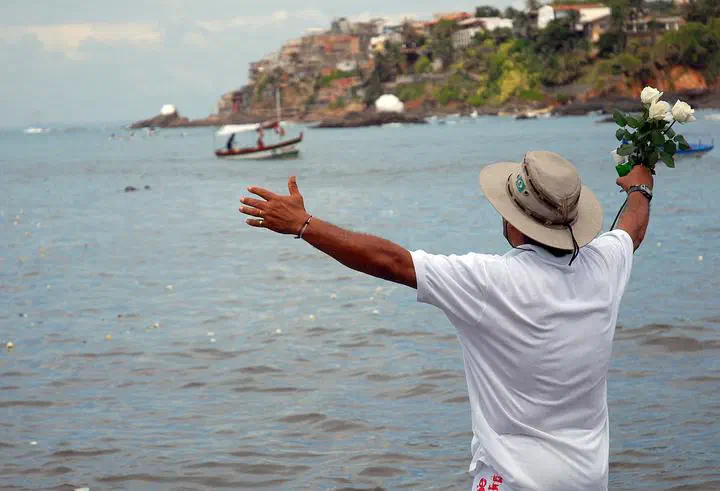 Greeting Iemanjá at the Rio Vermelho beach in Salvador da Bahia on 2 February. Photo: Fabio Rodrigues Pozzebom/Agência Brasil, CC BY 3.0 BR
Spend some time in capoeira and you’ll hear names like Iemanjá and Ogum in the songs, people wishing each other axé, and stories of capoeiristas whose bodies couldn’t be cut by a knife. They all come from Candomblé, the Afro-Brazilian religion that grew up in Bahia alongside capoeira. Here’s what Candomblé is, how the two are connected and how capoeira carries this heritage today.
What is Candomblé?
Candomblé is an Afro-Brazilian religion that took shape in Bahia in the 19th century. It was created by enslaved Africans and their descendants, who brought with them the religious traditions of their peoples, especially the Yoruba (from today’s Nigeria and Benin), the Fon and the Bantu peoples of Central Africa. These roots are still visible in the different nações (nations) of Candomblé, such as Ketu, Jeje and Angola.
At the heart of Candomblé are the orixás, divine forces linked to nature and to human life. A few of the best known:
- Oxalá, linked to creation, peace and the colour white.
- Iemanjá, the mother of the waters and queen of the sea.
- Ogum, the orixá of iron, roads and battle.
- Xangô, linked to thunder, fire and justice.
- Oxóssi, the hunter of the forest.
Candomblé is practised in temples called terreiros, with music, songs in African languages, dance and offerings. The atabaques are sacred drums there, and some of its ceremonies are open only to initiates.
Growing up side by side
Capoeira and Candomblé come from the same place and the same people: the Black communities of Salvador and the Recôncavo Baiano. For a long time they shared the same fate, too. While capoeira was a crime under the penal code from 1890, Candomblé terreiros were raided by the police, their drums and sacred objects taken away. In Bahia, terreiros had to register with the police into the 1970s.
Many capoeiristas were also members of terreiros, and the two traditions met at the same festivals, in the same streets and in the same families. It’s no surprise that they share so much.
Candomblé in capoeira
You can find traces of Candomblé all over the capoeira roda:
- Music: the atabaque, the call-and-response songs and the idea that music creates the energy of the circle.
- Songs: many capoeira songs mention orixás, especially Iemanjá, the queen of the sea, and Ogum, the warrior. Others name Catholic saints that are linked with orixás in Bahia, like Santa Bárbara.
- Words: axé comes from the Yoruba àṣẹ, the life force that makes things happen. In capoeira, axé is the good energy of a roda, and people say it to wish each other strength.
- Stories: the legend of Besouro Mangangá tells of a capoeirista with a corpo fechado, a “closed body” that knives and bullets couldn’t harm, protected by a patuá, an amulet. Read his story in Who was Besouro Mangangá?
- Rituals: some capoeiristas make a gesture or say a prayer at the foot of the berimbau before they play.
Folklore, faith and respect
So is capoeira a religion? No. Capoeira is a game, a fight, an art and a culture, and people of every faith, and of none, play it together. But it would be wrong to deny the spiritual side that Candomblé gave it. For many mestres and capoeiristas, especially in Bahia, the two are still deeply connected.
At Simplesmente Capoeira Berlin we see Candomblé as part of the folklore and history that capoeira carries with it: the songs we sing, the stories we tell and the words we use. Knowing where they come from is part of understanding capoeira, and of respecting the people who created it. You don’t need to belong to any religion to play capoeira with us.
Respect matters here. Candomblé is a living religion with millions of followers, and even today its followers and terreiros face prejudice and attacks in Brazil. Since 2007, Brazil has marked 21 January as the National Day against Religious Intolerance.
Orixás and saints
Why does a capoeira song about Santa Bárbara make people think of an orixá? During slavery and after, many orixás came to be associated with Catholic saints, a process known as syncretism. Read more in Orixás and Saints: Religious Syncretism in Bahia.
Watch
These videos are in Portuguese:
- O Candomblé e a Capoeira por Mestre Amen Santo: Mestre Amen Santo talks about Candomblé, capoeira and the African diaspora in Brazil, published by the Museu da Capoeira.
- Candomblé na Bahia (1977): a historical film from the collection of Brazil’s National Archives (Arquivo Nacional).
Discover capoeira in Berlin
Want to know more about the music and the history? Read The Berimbau and the Instruments of Capoeira or The History of Capoeira.
At Simplesmente Capoeira Berlin you’ll learn the movements, the music and the songs of capoeira, and the stories behind them. Come to a class in Schöneberg, Kreuzberg or Mitte: your first month is free.