Capoeira Angola vs Regional vs Contemporânea
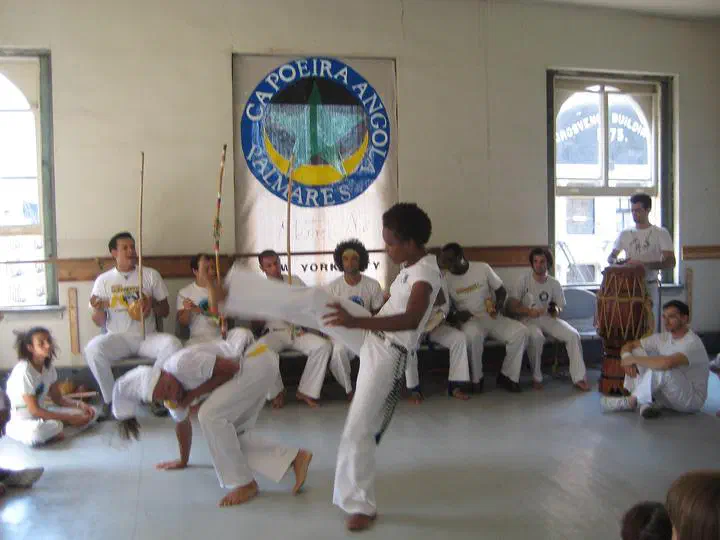 A Capoeira Angola game, with the bateria playing behind the players. Photo: TheTurducken, CC BY 2.0
If you start looking into capoeira, you’ll soon hear three names: Capoeira Angola, Capoeira Regional and Capoeira Contemporânea. They all come from the same roots and share the roda, the berimbau and the songs in Portuguese, but they play, train and even sound different. Here’s where each style comes from and how to tell them apart.
Where the styles come from
Until the 1930s there was simply capoeira, or capoeiragem, played in the streets, on the docks and at festivals, and banned by law since 1890. Things changed in Salvador da Bahia, where two masters took capoeira in two different directions:
- Mestre Bimba created a new, more athletic method in the late 1920s and opened his school in 1932. His style became Capoeira Regional.
- Mestre Pastinha took charge of a group of traditional capoeiristas in 1941 and founded a school to preserve the older way of playing, which became known as Capoeira Angola.
From the 1960s onwards, new groups, many of them in Rio de Janeiro and São Paulo, mixed what they learned from both lines. This is what most people today call Capoeira Contemporânea. You can read the full story in The History of Capoeira.
Capoeira Angola
Capoeira Angola takes its name from Angola in Africa, as a way of honouring capoeira’s African roots. It’s often described as the “mother” of all capoeira, though its form as a separate style also took shape in the 20th century, around Mestre Pastinha and other old masters of Bahia.
How it plays: the game is usually slow, low and close to the ground, though it can suddenly speed up. Players stay close to each other, use a lot of floor movement and look for openings with cunning (malícia) rather than speed. A good Angola game is like a conversation full of questions, traps and humour.
Ritual: the ritual is very important. The roda begins with a ladainha sung at the foot of the berimbau, and players use special moments like the chamada, where one player “calls” the other into a kind of ritual walk that tests attention and trust.
Music: a full bateria, often three berimbaus, two pandeiros, an atabaque, an agogô and a reco-reco.
What you’ll see: many Angola groups follow Mestre Pastinha’s tradition of training in trousers and a shirt tucked in, often with shoes, and in group colours rather than all white.
In the 1980s, masters like Mestre Moraes and Mestre Cobra Mansa led a revival of Capoeira Angola, and today it’s practised all over the world.
Capoeira Regional
Capoeira Regional was created by Mestre Bimba in Salvador, at first under the name Luta Regional Baiana. Bimba felt that the capoeira of his time had lost its effectiveness as a fight, so he built a more structured and efficient system.
How it plays: the game is faster, more upright and more direct, with kicks and counter-attacks that flow quickly into each other. It’s usually played to the toque São Bento Grande (de Regional).
Teaching method: Bimba introduced things that were new to capoeira:
- the sequências de ensino, fixed training sequences of attacks and defences practised with a partner;
- the cintura desprezada, a sequence of throws that teaches students to land safely;
- a graduation ceremony (formatura) and a first batizado, when new students played their first game to the berimbau.
Music: in Bimba’s roda the music was played by one berimbau and two pandeiros.
What you’ll see: students traditionally train in white.
Today Capoeira Regional is kept alive by Bimba’s students and their students, including his son Mestre Nenel and the Fundação Mestre Bimba in Salvador. Read more in Who was Mestre Bimba?
Capoeira Contemporânea
“Contemporânea” (contemporary) isn’t a single style created by one master. It’s the name for the way of playing that most groups around the world follow today, which draws on both Angola and Regional.
How it plays: groups usually train both a fast game and a slow game, and the toque of the berimbau decides which game is played: São Bento Grande for a quick, acrobatic game, Angola or São Bento Pequeno for a low, close game, Benguela for a flowing one, and so on. Many groups add acrobatic movements (floreios).
Teaching and grading: most contemporary groups use coloured cords (cordas) to show a student’s level, with a batizado where students get new cords. Each group has its own colour system.
Music: usually three berimbaus, a pandeiro and an atabaque, but it varies from group to group.
What you’ll see: many groups train in white trousers (abadás) and the group’s T-shirt.
Quick comparison
| Angola | Regional | Contemporânea | |
|---|---|---|---|
| Associated with | Mestre Pastinha (1941) | Mestre Bimba (1932) | Many groups from the 1960s on |
| Typical game | Low, slow, strategic | Fast, upright, direct | Changes with the toque |
| Music | Full bateria | 1 berimbau, 2 pandeiros | Usually 3 berimbaus, pandeiro, atabaque |
| Grading | Varies, often no cords | Bimba’s own ceremonies | Coloured cords and batizado |
These are generalisations. Every group and every mestre has their own way of doing things, and the lines between the styles are often blurry. As many mestres say: in the end, it’s all capoeira.
Watch the styles
These videos are in Portuguese, except the UNESCO film:
- Professor explica a diferença entre a Capoeira Angola e a Capoeira Regional: a short report from Brazil’s public broadcaster TV Brasil.
- Capoeira contemporânea existe?: Mestre Koioty on the differences between Angola, Regional and Contemporânea.
- Capoeira circle: UNESCO’s film about the roda, which it added to the list of the Intangible Cultural Heritage of Humanity in 2014.
- Roda de Capoeira: Patrimônio Cultural Imaterial da Humanidade: a documentary by IPHAN, Brazil’s national heritage institute.
Try it in Berlin
Our group anthem, Himno Simplesmente Capoeira, sings “Rápido como São Bento, ou Angola devagar”: fast like São Bento, or slow like Angola. The best way to feel the difference is to play.
New to capoeira? Start with What is Capoeira? To learn about the music, read The Berimbau and the Instruments of Capoeira.
Come and train with Simplesmente Capoeira Berlin in Schöneberg, Kreuzberg or Mitte. No experience needed, and your first month is free.