The History of Capoeira
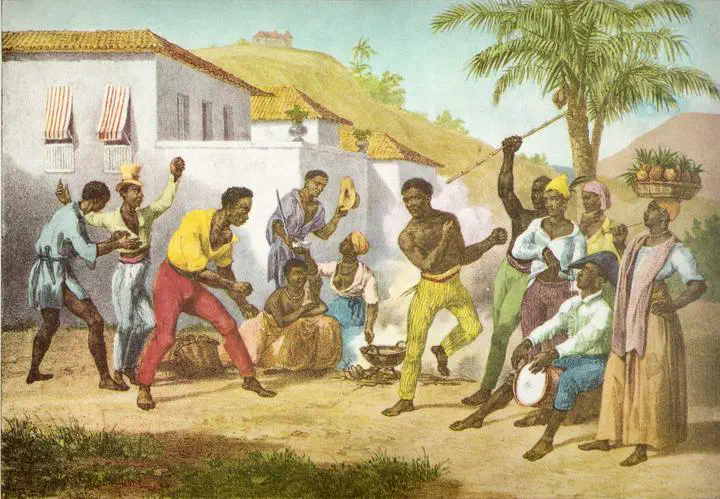 Johann Moritz Rugendas, Jogar Capoëira ou danse de la guerre (around 1830), one of the oldest known images of capoeira. Public domain, via Wikimedia Commons.
Capoeira was born out of one of the darkest chapters in history: the enslavement of millions of Africans in Brazil. What began as a way to survive, keep culture alive and resist became a martial art, then a crime, then a national sport, and finally a world heritage practised in well over a hundred countries. This is the story, from the plantations of colonial Brazil to training halls in Berlin.
African roots, Brazilian birth
Between the 16th and the 19th century, around four to five million Africans were taken to Brazil as slaves, more than to any other country in the Americas. Many came from Central Africa, from the region of today’s Angola and Congo, and others from West Africa. They brought their languages, religions, music and fighting and dance traditions with them.
Capoeira’s exact beginnings were never written down, and historians still debate them. Most agree on two things. Its roots lie in African traditions of movement, music and ritual combat; a dance-fight from southern Angola called engolo (or n’golo) is often named as one ancestor. And capoeira as we know it took shape in Brazil, among enslaved Africans and their descendants, mixing traditions from many African peoples in a new place.
Where the name comes from is also debated. One popular explanation is a word from the indigenous Tupi language for areas of low, cleared vegetation, where people may have practised away from the eyes of their masters.
A fight disguised as a dance
Enslaved people were forbidden to train for combat. According to capoeira tradition, they disguised their fighting as a dance: kicks and escapes hidden in rhythm, music and play. Whether or not it happened exactly like that, the idea runs through capoeira to this day. Malícia (cunning) and mandinga (a kind of magic and trickery) are still at the heart of the game: never show what you are really going to do.
Capoeira also lived in the quilombos, communities founded by people who had escaped slavery. The largest and most famous was Palmares in north-eastern Brazil, which resisted the Portuguese for most of the 17th century under leaders like Zumbi dos Palmares. Capoeira songs and stories celebrate Zumbi as a symbol of freedom, and the day of his death, 20 November, is commemorated in Brazil as the Day of Black Consciousness. Read his story in Who was Zumbi dos Palmares?
In the streets of Rio and Salvador
The first written records of capoeira appear in the early 19th century, mostly in police records from Rio de Janeiro, where enslaved and free Black men were arrested for “capoeira”. Around 1830 the German painter Johann Moritz Rugendas painted Jogar Capoëira ou danse de la guerre (“Playing capoeira, or the dance of war”), one of the oldest known images of capoeira: two men facing each other in a circle, with a drum and onlookers. It’s the painting at the top of this page.
During the 19th century capoeira became part of urban life. In Rio, gangs of capoeiristas called maltas, like the rival Nagoas and Guaiamuns, controlled neighbourhoods and were hired by politicians as muscle. Capoeiristas also fought for Brazil in the Paraguayan War (1864–1870). Capoeira had a dangerous reputation, and the authorities wanted it gone.
Abolition and the ban
Brazil was the last country in the Americas to abolish slavery, with the Lei Áurea of 13 May 1888. Freedom did not bring equality. Just two years later, the penal code of 1890 made capoeira a crime: anyone caught practising it in the streets could be imprisoned, and leaders of groups faced harsher punishment.
For decades capoeira survived underground, especially in Bahia. It was played in hidden places and at religious festivals, with lookouts and a special berimbau rhythm, the cavalaria, that is said to have warned players when the mounted police were coming. This is the era of legendary figures like Besouro Mangangá (1895–1924) from Santo Amaro in Bahia, a capoeirista famous for standing up to the police and the powerful, about whom many capoeira songs are still sung. Read his story in Who was Besouro Mangangá?
Mestre Bimba, Mestre Pastinha and the first academies
In the 1930s the political climate in Brazil changed, and two masters from Salvador da Bahia brought capoeira out of the shadows.
Mestre Bimba (Manoel dos Reis Machado, 1899–1974) created a new, more athletic and systematic style he called Luta Regional Baiana, today known as Capoeira Regional. In 1932 he opened one of the first capoeira academies, and in 1937 his school received official recognition from the state authorities. Bimba introduced structured teaching sequences, graduation ceremonies and the idea of capoeira as a sport for students from all social classes. Read his story in Who was Mestre Bimba?
Mestre Pastinha (Vicente Ferreira Pastinha, 1889–1981) set out to preserve the older tradition, which became known as Capoeira Angola. In 1941 he founded the Centro Esportivo de Capoeira Angola in Salvador. Pastinha was a philosopher of capoeira as much as a teacher, and in 1966 he travelled with his students to the First World Festival of Negro Arts in Dakar, Senegal. Read his story in Who was Mestre Pastinha?
When Brazil’s new penal code came into force in 1940, capoeira was no longer listed as a crime. Within a few decades it went from being persecuted to being celebrated as a symbol of Brazilian culture.
From Bahia to the world
From Salvador, capoeira spread to Rio de Janeiro, São Paulo and across Brazil. Many groups combined elements of Angola and Regional into what is now called Capoeira Contemporânea. From the 1970s onwards, Brazilian mestres began to emigrate and teach in the United States and Europe, and capoeira grew into a global community.
Recognition followed. In 2008 Brazil’s national heritage institute, IPHAN, registered the capoeira circle and the craft of the capoeira masters as Brazilian cultural heritage. In 2014 UNESCO inscribed the capoeira circle on the list of the Intangible Cultural Heritage of Humanity. Read more in Capoeira as UNESCO Intangible Cultural Heritage.
Capoeira today, and in Berlin
Today capoeira is practised in well over a hundred countries, and every roda still carries its history. The songs in Portuguese tell of slavery and freedom, of Zumbi, Besouro, Bimba and Pastinha. The berimbau rhythms, the ritual at the foot of the berimbau and the respect for the mestres connect every capoeirista to the people who kept this art alive when it was forbidden.
At Simplesmente Capoeira Berlin we pass on that history alongside the movements and the music. If you want to understand capoeira, the best way is to play it: come to a class in Schöneberg, Kreuzberg or Mitte, and your first month is free.
New to capoeira? Start with What is Capoeira?