What is Maculelê?
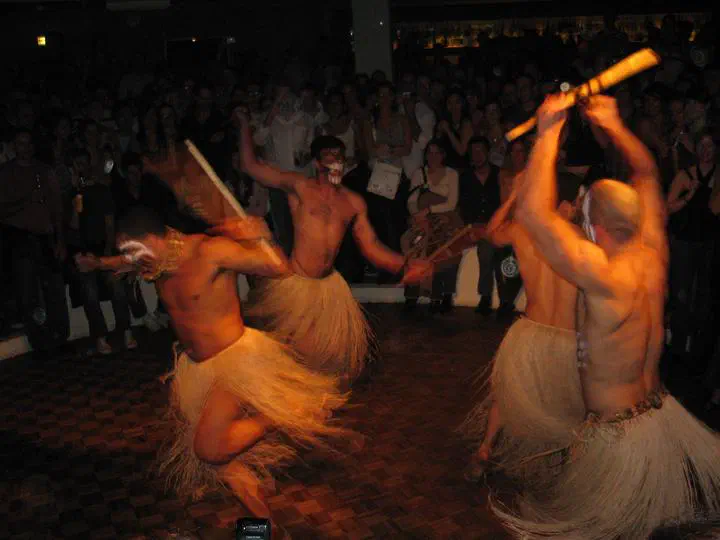 Maculelê at a batizado in Brazil. Photo: Beverly Trayner, CC BY 2.0
Maculelê is an Afro-Brazilian dance played with two wooden sticks. Dancers move in a circle to the beat of the atabaque and strike their sticks against each other’s in rhythm, faster and faster, as if in a mock battle. It comes from the Recôncavo region of Bahia, the same part of Brazil that gave the world capoeira and samba de roda, and today it is danced by capoeira groups all over the world.
Where maculelê comes from
Maculelê is most closely linked to Santo Amaro da Purificação, a town in the Recôncavo Baiano, the fertile land around the Bay of All Saints where sugar plantations once depended on the work of enslaved Africans. Its exact origins are not known. Most researchers see African roots in it, especially in the stick-fighting and warrior dances of Central and West Africa, and some also see influences from Indigenous Brazilian dances.
In the 19th century, maculelê was danced in Santo Amaro during religious festivals, especially the feast of Nossa Senhora da Purificação, the town’s patron saint, on 2 February. Over time it almost disappeared.
Mestre Popó and the revival
Maculelê survived thanks to Mestre Popó (Paulino Aluísio de Andrade) of Santo Amaro. In the 1940s he gathered relatives and friends, put together the movements and songs remembered by the older people of the town and formed a group to dance it again at the festivals. He is remembered as the father of modern maculelê.
From Santo Amaro, maculelê spread to Salvador. In the following decades capoeira mestres and folklore groups put it on stage in shows about Afro-Brazilian culture, and from there it travelled with capoeira around the world.
The legend of Maculelê
There are several versions of the story behind the name. In the best known one, Maculelê was a young man who was not fully accepted by his village. One day, while the other men were away hunting, a rival tribe attacked. Maculelê defended the women, the children and the elders on his own, armed only with two sticks, and drove the attackers away. Since then the dance has honoured his courage.
Like many stories in capoeira, this is a legend, not documented history. But it explains why maculelê is danced as a battle, with energy and pride.
How maculelê is danced
- The sticks: each dancer holds two wooden sticks, called grimas, about 50 to 60 centimetres long. In some performances, experienced dancers use machetes (facões) instead, striking sparks from the blades.
- The circle: the dancers form a circle. Pairs enter the middle and strike their sticks against each other’s in rhythm, crossing, turning and crouching, while the others keep the beat.
- The music: the atabaques lead, often several of them, with call-and-response songs in Portuguese mixed with words of African origin. The strikes of the sticks are part of the music.
- The look: on stage, dancers often wear straw skirts and paint white marks on their skin, a stylised costume that became common in shows from the 1960s on.
The strikes follow the rhythm exactly, so maculelê trains timing, coordination and trust in your partner. It’s also loud, fast and a lot of fun to watch.
Maculelê and capoeira
Maculelê and capoeira grew up in the same communities, and many of the people who kept one alive also practised the other. Today a lot of capoeira groups learn maculelê alongside capoeira, and it is often part of batizados, festivals and shows, together with samba de roda, the other great tradition of the Recôncavo. Read about it in What is Samba de Roda?
Watch
These videos are in Portuguese:
- Maculelê (1972): a short historical film from the collection of Brazil’s National Archives (Arquivo Nacional).
- História do Maculelê: the historian Antônio Liberac talks about the history of maculelê, published by the Museu da Capoeira.
Discover Afro-Brazilian culture in Berlin
Capoeira is more than a game: it carries music, dances and stories from Bahia. To see where it all started, read The History of Capoeira or learn about the drums in The Berimbau and the Instruments of Capoeira.
At Simplesmente Capoeira Berlin you can get to know this culture from the inside. Come to a class in Schöneberg, Kreuzberg or Mitte: no experience needed, and your first month is free.