Who was Mestre Bimba?
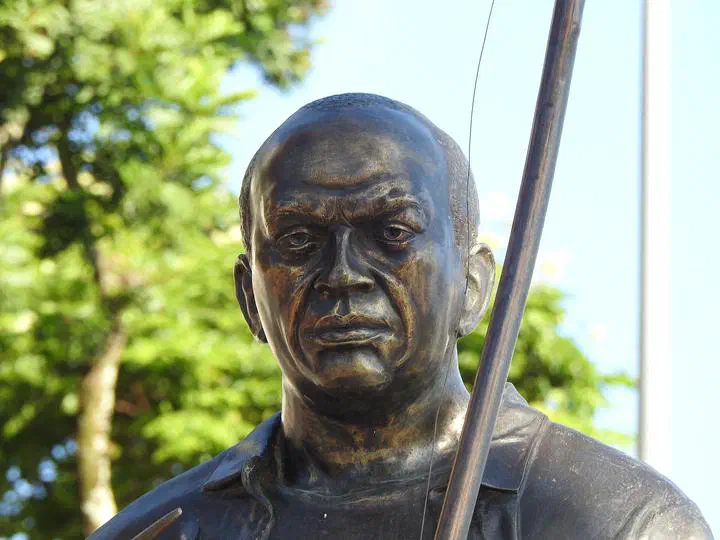 Statue of Mestre Bimba with his berimbau at the Arena da Capoeira in Salvador da Bahia. Photo: Sturm, CC BY-SA 4.0
Mestre Bimba, born Manoel dos Reis Machado, is one of the two great masters of 20th-century capoeira. At a time when capoeira was still a crime in Brazil, he created a new style, Capoeira Regional, opened one of the first capoeira schools and brought capoeira out of the streets and into academies, universities and, eventually, the whole world. Almost every capoeira group today, including ours in Berlin, owes something to his work.
Early life in Salvador
Manoel dos Reis Machado was born on 23 November 1899 in Engenho Velho de Brotas, a neighbourhood of Salvador da Bahia. Some sources, including his tomb, give the year as 1900. His father, Luiz Cândido Machado, was known as a champion of batuque, a hard Afro-Brazilian fighting game in which players tried to knock each other down with their legs.
According to a well-known story, his nickname comes from his birth: his mother and the midwife bet on whether the baby would be a boy or a girl, and when he was born the midwife announced the boy with bimba, a Bahian slang word for a boy’s private parts. The name stuck.
At about 12 years old Bimba began learning capoeira from Bentinho, an African who worked as a captain for a Bahian shipping company, in the area now called Liberdade in Salvador. As a young man Bimba worked at many jobs, including as a dock worker, carpenter and coal carrier, while becoming known as a strong capoeirista.
Creating Capoeira Regional
Bimba felt that the capoeira he saw around him had become too much of a show and was losing its effectiveness as a fight. In the late 1920s he began building his own method, adding movements from batuque and other fighting styles to traditional capoeira. He called it Luta Regional Baiana, the “regional fight of Bahia”. Calling it a luta rather than capoeira also helped at a time when capoeira itself was against the law.
In 1932 he opened his school, the Centro de Cultura Física Regional, in Salvador. In 1937 it was officially registered by the state authorities, making it one of the first capoeira schools in Brazil to be recognised. For capoeira, which had been treated as a crime for almost 50 years, this was a turning point.
A new way of teaching
Bimba’s biggest innovation was not a kick, but a method. For the first time, capoeira was taught step by step in a structured way:
- Admission test: new students started with simple tests of strength and flexibility.
- Sequências de ensino: eight fixed sequences of attacks and defences, practised with a partner. Many groups still use them, or versions of them, today.
- Cintura desprezada: a series of throws in which one partner lifts the other, who has to land on their feet. It trains trust, agility and safe falling.
- Batizado: the first time a new student played to the berimbau in the roda. Today the batizado is one of the most important celebrations in capoeira.
- Formatura: a graduation ceremony for students who completed the course, who received a blue silk scarf.
Bimba also had clear rules for his students: stop smoking and drinking, train regularly, don’t show off your capoeira to friends outside the academy, and always talk little and observe a lot.
His roda had its own music, one berimbau and two pandeiros, and its own toques, including São Bento Grande de Regional, Banguela, Iúna, Cavalaria, Santa Maria, Amazonas and Idalina. The Iúna was played only for graduated students, who played a special game with throws. Read more about the music in The Berimbau and the Instruments of Capoeira.
Capoeira gets respect
Bimba’s students included university students, doctors, lawyers and military officers, people who would never have been seen doing capoeira a generation earlier. To join, students had to show they were working or studying. This helped change capoeira’s image in Brazilian society.
In 1953 Bimba and his students gave a demonstration for the President of Brazil, Getúlio Vargas. Vargas is said to have called capoeira “the only truly national sport”. By then capoeira was no longer listed as a crime in the penal code, and it was on its way to becoming a symbol of Brazilian culture.
Last years
Despite his fame, Bimba never became rich, and he felt that the authorities in Bahia didn’t give him the support they had promised. In 1973, disappointed, he moved to Goiânia, in central Brazil, where a former student had invited him to teach. He died there on 5 February 1974. His remains were later brought back to Salvador, where his tomb calls him o rei da capoeira, “the king of capoeira”.
His legacy
Bimba’s son Mestre Nenel (Manoel Nascimento Machado) continues his father’s Capoeira Regional in Salvador through the Fundação Mestre Bimba and the group Filhos de Bimba. Bimba’s students went on to teach all over Brazil, and through them and their students his method reached the world.
Many things that capoeiristas everywhere take for granted, from training sequences and graduation ceremonies to the batizado and the idea of a capoeira academy, go back to Mestre Bimba. Together with Mestre Pastinha, who chose a different path, he is the reason capoeira survived and grew in the 20th century. Read about him in Who was Mestre Pastinha?
Watch
These videos are in Portuguese:
- Mestre Bimba – De Lá Pra Cá: a programme about Mestre Bimba by Brazil’s public broadcaster TV Brasil (part 1 of 2).
- Mestre Nenel: filho de Mestre Bimba mantém viva a Capoeira Regional: a report by TVE Bahia about Bimba’s son and his work in Salvador.
Train in Berlin
Want to see how capoeira is played and taught today? Read Capoeira Angola vs Regional vs Contemporânea or The History of Capoeira. Our group anthem, the Himno Simplesmente Capoeira, even sings about “Bimba da Regional”.
At Simplesmente Capoeira Berlin we train the kicks, sequences and music that grew out of the work of mestres like Bimba. Come and try it in Schöneberg, Kreuzberg or Mitte: your first month is free.