Who was Mestre Pastinha?
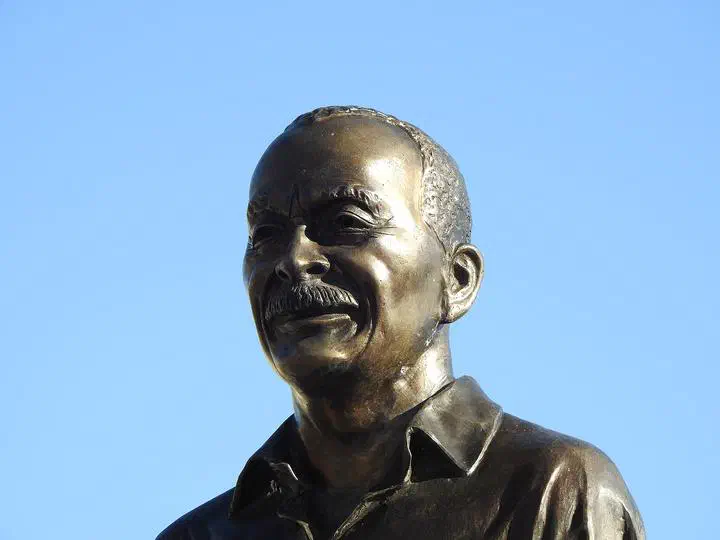 Statue of Mestre Pastinha at the Arena da Capoeira in Salvador da Bahia. Photo: Sturm, CC BY-SA 4.0
Mestre Pastinha, born Vicente Ferreira Pastinha, is the master most closely linked to Capoeira Angola. While Mestre Bimba created a new style, Pastinha set out to protect the old one. He founded the first school dedicated to Capoeira Angola, wrote about capoeira as a philosophy of life and took it to Africa. He died poor and almost blind, but today he is honoured as one of the greatest mestres in capoeira’s history.
Childhood and his first teacher
Vicente Ferreira Pastinha was born in Salvador da Bahia on 5 April 1889, a year after slavery ended in Brazil. His father, José Señor Pastinha, was a Spanish immigrant, and his mother, Raimunda dos Santos, was a Black woman from Bahia.
Pastinha himself told the story of how he found capoeira. As a small boy he was regularly beaten up by an older, stronger boy. An old African man named Benedito, from Angola, watched this happen from his window and offered to teach him. After learning capoeira from him, Pastinha won the next fight so clearly that the older boy left him alone from then on.
At 12 he entered the Navy apprentice school (Escola de Aprendizes Marinheiros) in Salvador, where he taught capoeira to other students. Later he worked at many jobs to make a living. He also had real artistic talent: he painted, and his own drawings of capoeira movements still survive.
Taking charge of Capoeira Angola
For many years Pastinha was away from the rodas. In 1941, a former student named Aberrê brought him to a famous Sunday roda at the Ladeira do Gengibirra in Salvador, where some of the best capoeiristas of Bahia played. Its leader, Mestre Amorzinho, asked Pastinha to take charge of the group and protect the tradition.
Out of that roda came the Centro Esportivo de Capoeira Angola (CECA), which Pastinha led for the rest of his active life. The school was officially registered in 1952. In the 1950s it moved to the Largo do Pelourinho in Salvador’s historic centre, where it became a meeting place for capoeiristas, artists, writers and visitors from around the world.
Pastinha gave his school a clear identity. His students wore black trousers and yellow shirts, the colours of his favourite football club, Ypiranga, and played in shoes. He insisted on discipline, respect, ritual and music, with a full bateria of berimbaus, pandeiros, atabaque, agogô and reco-reco.
The philosopher of capoeira
What made Pastinha special was the way he talked about capoeira. For him it wasn’t only a fight or a game, but a way of understanding life. In 1964 he published a book, Capoeira Angola, and many of his sayings are still repeated today. One of the best known is:
“Capoeira é mandinga de escravo em ânsia de liberdade; seu princípio não tem método e seu fim é inconcebível ao mais sábio capoeirista.”
“Capoeira is the mandinga of slaves longing for freedom; its beginning has no method and its end is beyond the understanding of the wisest capoeirista.”
He also used to say that capoeira is “everything the mouth eats” (tudo o que a boca come), meaning that it holds everything: fight, dance, music, ritual and life itself.
Pastinha was a friend of artists like the writer Jorge Amado, the painter Carybé and the photographer Pierre Verger, who helped make his academy and Capoeira Angola known far beyond Bahia.
Dakar 1966
In 1966 Pastinha travelled with a group of his students to the First World Festival of Black Arts in Dakar, Senegal, as part of the Brazilian delegation. For the old master, who had learned capoeira from an African, presenting Capoeira Angola in Africa was a powerful moment that showed capoeira’s place in the culture of the African diaspora.
A hard end
Pastinha’s last years were difficult. His eyesight was failing, and in the early 1970s he lost his academy in the Pelourinho when the building was taken over for restoration work, with a promise that he would get it back. The promise was never kept. He spent his final years in poverty and died on 13 November 1981, at the age of 92, in a shelter in Salvador.
His legacy
Pastinha’s students carried his capoeira on. Two of the most important were Mestre João Grande and Mestre João Pequeno. João Pequeno taught for decades at the Forte Santo Antônio Além do Carmo in Salvador, now known as the “Forte da Capoeira”. João Grande took Capoeira Angola to New York in 1990.
In the 1980s a new generation of mestres led a revival of Capoeira Angola, and Pastinha became its symbol. Today his name is sung in rodas everywhere, and his statue stands alongside Mestre Bimba’s and other great mestres’ at the Arena da Capoeira in Salvador, pictured above. Read about Bimba in Who was Mestre Bimba?
Watch
These videos are in Portuguese:
- Mestre Pastinha, Rei da Capoeira: a documentary by the Bahian public broadcaster TVE Bahia.
- Pastinha! Uma Vida pela Capoeira: the 1998 documentary by Toninho Muricy, published on the director’s own channel.
Discover Capoeira Angola in Berlin
Want to understand how Pastinha’s Capoeira Angola differs from other styles? Read Capoeira Angola vs Regional vs Contemporânea, or go back to the beginning with The History of Capoeira.
At Simplesmente Capoeira Berlin you’ll learn the movements, music and rituals that mestres like Pastinha kept alive. Come and feel it for yourself in Schöneberg, Kreuzberg or Mitte: your first month is free.