What is Samba de Roda?
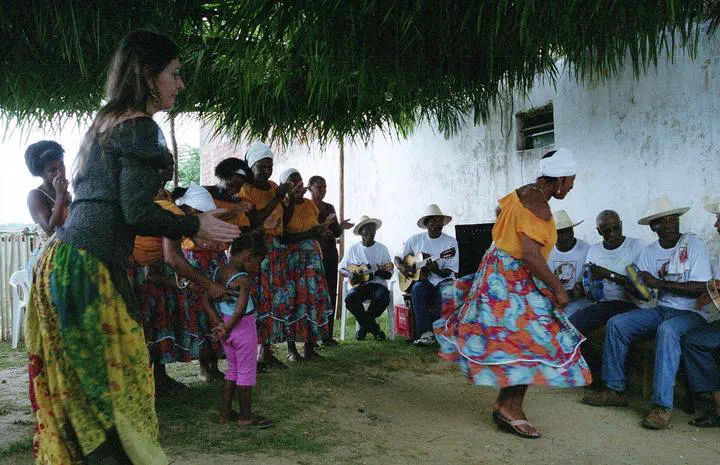 Samba de roda in the Recôncavo Baiano. Photo: Maria Eugenia Tita, CC BY 4.0
Samba de roda (“samba in a circle”) is a tradition of music, poetry and dance from the Recôncavo Baiano, the region around the Bay of All Saints in Bahia. People stand in a circle, sing, clap and play, while one person after another dances in the middle. It is one of the roots of Brazilian samba, it is on UNESCO’s list of the Intangible Cultural Heritage of Humanity, and for many capoeiristas it is how a roda ends: with everyone singing and dancing together.
Where samba de roda comes from
Samba de roda grew out of the music and dances of enslaved Africans in the sugar plantations and towns of the Recôncavo, such as Santo Amaro, Cachoeira and São Félix. It mixed African rhythms, circle dances and call-and-response singing with elements of Portuguese culture, such as the viola (a small guitar) and the language of the songs. It was danced at family parties, after work and at religious festivals, often after Candomblé ceremonies or during celebrations for Catholic saints.
In the late 19th and early 20th centuries, many people from Bahia moved to Rio de Janeiro. In their houses, especially in the community around the famous Tia Ciata, the Bahian samba met other styles, and from these meetings the urban samba of Rio was born. That’s why samba de roda is often called one of the roots of samba.
How samba de roda is played
Everyone in the circle takes part: singing, answering the songs, clapping (palmas) and playing. The usual instruments are:
- Pandeiro, the frame drum with jingles that you also find in the capoeira roda.
- Viola machete, a small Bahian guitar, in the traditional samba chula.
- Atabaque and agogô.
- Prato e faca: a plate scraped with a knife, a simple kitchen instrument that gives samba de roda its special sound.
The dance is light and quick, done with small, shuffling steps of the feet while the upper body stays relaxed. This step is called the miudinho. Traditionally women dance in the middle and men play the instruments, although today everyone joins in. When a dancer finishes, they invite the next person into the circle, traditionally with an umbigada, a light touch of the belly (umbigo, navel) or a gesture towards it.
There are two main forms:
- Samba chula: the singers sing a verse called the chula, and nobody dances while it is sung. Then the relativo follows, and one dancer at a time enters the circle.
- Samba corrido: shorter, quicker songs answered by everyone, with dancing going on all the time.
UNESCO heritage
In 2004, Brazil’s national heritage institute IPHAN registered the Samba de Roda do Recôncavo Baiano as Brazilian cultural heritage. In 2005, UNESCO proclaimed it a Masterpiece of the Oral and Intangible Heritage of Humanity, and since 2008 it has been on UNESCO’s Representative List. The roda de capoeira followed in 2014: read Capoeira as UNESCO Intangible Cultural Heritage.
Samba de roda and capoeira
Capoeira and samba de roda share a lot: the circle, the pandeiro and atabaque, call-and-response songs and the same roots in the Recôncavo. Many old capoeiristas were also sambadores. In many groups, a capoeira roda or a big event ends with samba de roda, with the berimbaus put away and everyone, from beginners to mestres, dancing in the middle in turn. It’s also a common part of batizados and festivals, together with maculelê: read What is Maculelê?
Watch and listen
These videos are in Portuguese, but you’ll catch the rhythm:
- Samba de Roda do Recôncavo Baiano: a documentary by IPHAN, Brazil’s national heritage institute.
- Samba de Roda, Patrimônio Imaterial da Humanidade: 15 Anos de Salvaguarda e Conquistas: a documentary by ASSEBA, the association of samba de roda players of Bahia.
Feel the rhythm in Berlin
Want to know more about the music behind the roda? Read The Berimbau and the Instruments of Capoeira or start with What is Capoeira?
At Simplesmente Capoeira Berlin music, singing and clapping are part of every class. Come and try it in Schöneberg, Kreuzberg or Mitte: your first month is free.