Orixás and Saints: Religious Syncretism in Bahia
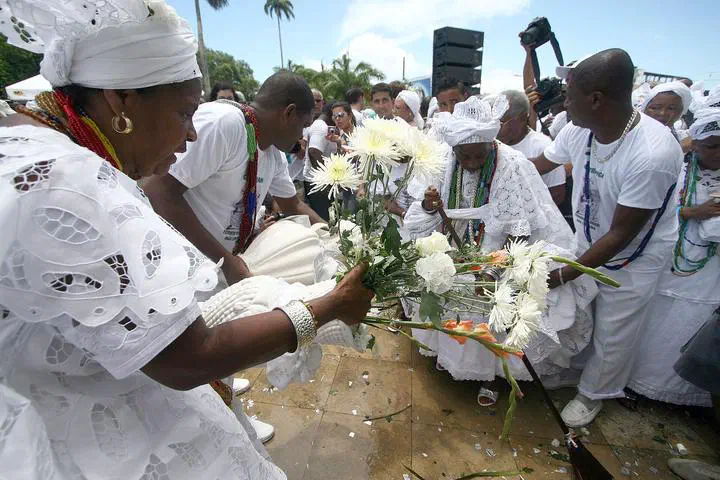 Baianas at the Lavagem do Bonfim in Salvador da Bahia, 2010. Photo: Adenilson Nunes/AGECOM, CC BY 2.0
In Bahia, a Catholic saint and an orixá can share a feast day, a colour and even a song. Every January, women dressed in white wash the steps of a Catholic church in Salvador with scented water, in honour of both Jesus and Oxalá. This blending of religions is called syncretism, and it’s everywhere in Afro-Brazilian culture, capoeira included. Here’s where it comes from and what it means.
What is syncretism?
Syncretism is the mixing or linking of different religious traditions. In Brazil the word usually describes how the orixás, the divine forces of Afro-Brazilian religions like Candomblé, came to be associated with Catholic saints. If you don’t know the orixás yet, start with Candomblé and Capoeira.
How it happened
During slavery, the Catholic Church was the official religion of colonial Brazil. Enslaved Africans were baptised and expected to worship the saints, while their own religions were forbidden or treated with suspicion.
A common explanation is that they hid their orixás behind the saints: praying in front of a statue of Saint Barbara, for example, while honouring Iansã. Historians add that it wasn’t only a disguise. Catholic brotherhoods (irmandades) of Black people were among the few places where Africans and their descendants could meet, organise and celebrate, and over generations many people sincerely took part in both traditions. The links between saints and orixás were often based on real similarities: a warrior saint for a warrior orixá, a saint of the sea for the queen of the sea.
Orixás and their saints
The pairs differ from region to region. These are some of the most common ones in Bahia:
| Orixá | Linked to | Saint |
|---|---|---|
| Oxalá | creation, peace, white | Senhor do Bonfim (Jesus) |
| Iemanjá | the sea, motherhood | Nossa Senhora da Conceição |
| Ogum | iron, roads, battle | Santo Antônio |
| Oxóssi | the hunt, the forest | São Jorge |
| Iansã | wind, storms | Santa Bárbara |
| Xangô | thunder, justice | São Jerônimo |
| Omolu / Obaluaê | illness and healing | São Lázaro, São Roque |
| Ibeji | the twins | São Cosme and São Damião |
In Rio de Janeiro, for example, Ogum is linked to São Jorge and Oxóssi to São Sebastião instead.
The Lavagem do Bonfim
The best-known symbol of syncretism in Bahia is the Lavagem do Bonfim, the “washing of Bonfim”. Every year on the second Thursday of January, a huge procession walks about eight kilometres from the Conceição da Praia church in Salvador’s lower city to the Church of Senhor do Bonfim. At the front go the baianas, women in white dresses carrying jugs of scented water (água de cheiro) and flowers. At the church they wash the steps and the courtyard, while the crowd sings and celebrates.
For Catholics it’s a feast for the Senhor do Bonfim, Jesus. For many followers of Candomblé it’s also a celebration of Oxalá, whose colour is white. Both are present at the same time.
Not everyone agrees
Syncretism is also debated. In 1983, a group of leading priestesses (ialorixás) of Salvador’s oldest terreiros, among them Mãe Stella de Oxóssi, published a statement rejecting syncretism. They argued that it came from a time of oppression, and that Candomblé is a religion in its own right, which doesn’t need Catholic saints to be accepted. Others see syncretism as part of their faith and identity. Both views are part of Bahia today.
Syncretism in capoeira
Capoeira grew up in the same world, and you can hear it:
- In the louvação, the call that follows the opening song of a roda, players sing “Iê, viva meu Deus”: praise to God, in a ritual with African roots.
- The famous toques São Bento Grande and São Bento Pequeno carry the name of a Catholic saint, Saint Benedict.
- Many songs mention Santa Bárbara, Nossa Senhora or the Senhor do Bonfim, and for many singers these names also carry the memory of the orixás.
- Some capoeiristas cross themselves at the foot of the berimbau before they play, a Catholic gesture inside an Afro-Brazilian ritual.
Like the songs about Iemanjá and Ogum, these are part of the folklore that capoeira carries with it. You don’t have to be religious to sing them, but knowing what they mean makes the roda richer.
Watch
These videos are in Portuguese:
- Documentário Festa do Bonfim (2004): a documentary about the Festa do Bonfim and its washing, by the Bahian public broadcaster TVE Bahia.
- Sincretismo: qual a relação entre santos católicos, orixás e colonialismo?: a short explainer by the Brazilian news site UOL.
Sing it in Berlin
To learn more about the songs and the instruments, read The Berimbau and the Instruments of Capoeira or go back to The History of Capoeira.
At Simplesmente Capoeira Berlin, singing in Portuguese is part of every roda, and you’ll learn what the songs are about. Come to a class in Schöneberg, Kreuzberg or Mitte: your first month is free.