What is Capoeira?
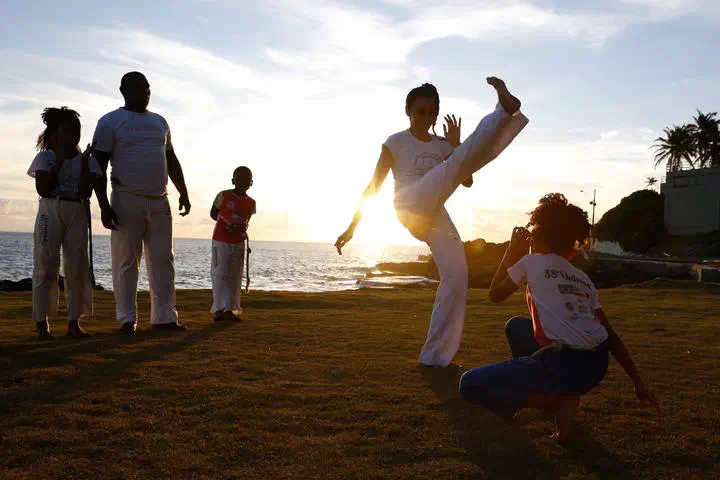 A capoeira roda at sunset in Salvador da Bahia, Brazil. Photo: Clara Angeleas / Ministério da Cidadania, CC BY 2.0
Capoeira is an Afro-Brazilian art that combines fight, dance, acrobatics and music in one practice. Two people play a game in the middle of a circle of singing, clapping people, while a single-string instrument called the berimbau sets the rhythm. It isn’t a fight to win and it isn’t a choreographed dance. It’s a conversation in movement.
Capoeira was created in Brazil by enslaved Africans and their descendants. Today it is practised all over the world, from Salvador da Bahia to Berlin. In 2014 UNESCO recognised the capoeira circle as part of the Intangible Cultural Heritage of Humanity. Read more in Capoeira as UNESCO Intangible Cultural Heritage.
A game, not a fight
In capoeira you don’t “fight” someone: you play (jogar) with them. The meeting of two players is called a jogo, a game. One player attacks with a kick, the other escapes, and the escape becomes the start of the next movement. Good capoeiristas don’t try to hit hard. They try to find openings, show that they could have landed a kick, and keep the game flowing.
That’s why capoeira is often called a dialogue: question and answer, attack and escape, played in rhythm with the music.
The roda: the circle where capoeira happens
Everything in capoeira comes together in the roda (Portuguese for “circle”).
- The group forms a circle and everyone claps and sings.
- At one end sits the bateria, the band of musicians.
- Two players crouch at the “foot of the berimbau” (pé do berimbau), greet each other and enter the circle with a cartwheel or a low movement.
- The music decides the game: a slow rhythm calls for a low, strategic game, a fast rhythm for an open, acrobatic one.
- Other players can “buy” the game (comprar o jogo) and step in, so the roda keeps changing.
A roda can last a few minutes or several hours, and it’s where everything you practise in training comes together.
The movements
Capoeira movement starts with the ginga, a constant swinging step that keeps you moving and hard to read. From the ginga come:
- Kicks such as the meia-lua de frente (half-moon kick), armada (spinning kick) and queixada.
- Escapes (esquivas) such as the cocorinha (a low crouch) and the negativa (dropping to the floor).
- Acrobatics (floreios) such as the aú (cartwheel), the macaco (a back handspring from the floor) and handstands.
- Takedowns and sweeps, used to surprise the other player rather than to hurt them.
You don’t need to be strong or flexible to start: capoeira training builds strength, flexibility, coordination and rhythm over time.
The music: berimbau, pandeiro and songs in Portuguese
Without music there is no roda. The main instruments are:
- Berimbau: a wooden bow with a steel string and a gourd. Usually three play together (gunga, médio and viola), and the berimbau leads the game.
- Pandeiro: a tambourine.
- Atabaque: a tall hand drum.
- Agogô (double bell) and reco-reco (a scraper).
More about each one in The Berimbau and the Instruments of Capoeira.
The songs are sung in Portuguese as call and response: a soloist sings a line and the circle answers in chorus. There are long solo songs called ladainhas that open the roda and short corridos sung during the game. Many of them tell the history of capoeira, its masters and the struggle against slavery. In our classes everyone learns to play the instruments and sing, not only to move.
Where does capoeira come from?
Capoeira grew out of the traditions of Africans brought to Brazil as slaves, many of them from the region of today’s Angola. Its exact beginnings aren’t recorded, but it developed over centuries as a way to train the body, keep culture alive and resist oppression, often disguised as a dance.
After slavery was abolished in 1888, capoeira was banned: the Brazilian penal code of 1890 made it a crime. In the 1930s it began to be accepted. In 1932 Mestre Bimba opened one of the first capoeira schools in Salvador da Bahia and created the style known as Capoeira Regional. In 1941 Mestre Pastinha founded a centre dedicated to the older, more traditional Capoeira Angola. From Bahia, capoeira spread across Brazil and, from the 1970s, around the world.
Read the full story in The History of Capoeira.
Capoeira Angola, Regional and Contemporânea
Today you will hear about three main styles:
- Capoeira Angola: slower, lower to the ground, strategic and deeply rooted in ritual and tradition.
- Capoeira Regional: faster and more upright, with a structured training method created by Mestre Bimba.
- Capoeira Contemporânea: the style of most groups today, combining elements of both.
Read more in Capoeira Angola vs Regional vs Contemporânea.
Cords, batizado and capoeira names
Most capoeira groups use coloured cords (cordas) worn around the waist to show a student’s level. A new student receives their first cord at a batizado (“baptism”), a big celebration where students play with masters and guests. Traditionally this is also when a capoeirista may get their capoeira nickname (apelido). At Simplesmente Capoeira Berlin our Batizado e Troca de Cordas brings capoeiristas from Berlin and abroad together.
Is capoeira a martial art or a dance?
Both, and more. Capoeira is a martial art because it trains attacks, escapes and takedowns. It looks like a dance because it moves to music and flows without stopping. And it’s a cultural tradition with its own language, songs, history and community. That mix is what makes it unique: you train your body, your musicality and your creativity at the same time.
Capoeira in Berlin
Berlin has a lively capoeira scene with groups from many styles. At Simplesmente Capoeira Berlin we train kids and adults in Schöneberg, Kreuzberg and Mitte. Beginners are welcome at every class, and you’ll learn the movements, the instruments and the songs step by step. Training is bilingual in German and English, the songs are sung in Portuguese, and the group is as international as the city.
Want to feel what a roda is like instead of reading about it? Come to a class: your first month is free.