Who was Zumbi dos Palmares?
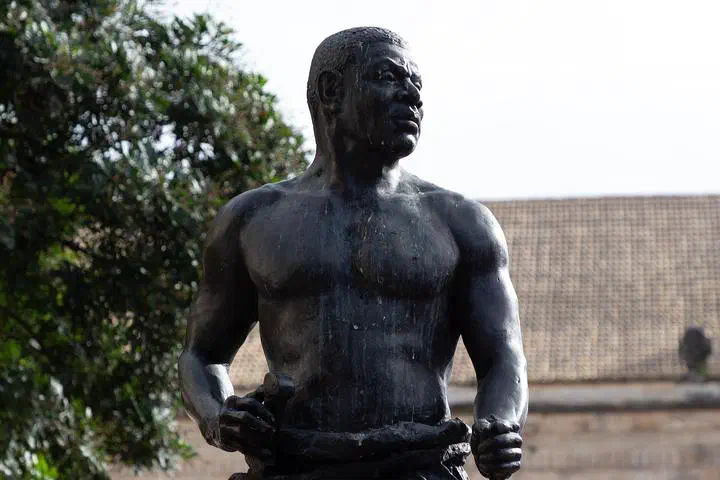 Statue of Zumbi dos Palmares on Praça da Sé in Salvador da Bahia. Photo: Wellington Da Costa Gomez, CC BY-SA 4.0
Zumbi dos Palmares was the last leader of Palmares, the largest and longest-lasting community of people who escaped slavery in Brazil. For decades Palmares resisted attack after attack from the Portuguese colonial army. Zumbi refused every deal that would have left others in chains, and he was killed on 20 November 1695. More than three centuries later he is one of Brazil’s national heroes, and his name is sung in capoeira rodas all over the world, including ours in Berlin.
Palmares: a free kingdom in the hills
From the 16th century onwards, enslaved Africans in Brazil escaped from the sugar plantations whenever they could. Many fled into the forests and hills and founded free settlements called quilombos (or mocambos).
The greatest of them was Palmares, in the mountains of the Serra da Barriga, in what was then the captaincy of Pernambuco and is today the state of Alagoas, in north-eastern Brazil. It was named after the many palm trees in the area. Palmares grew from the early 17th century into a network of villages that, by most estimates, was home to thousands and possibly tens of thousands of people. Most were Africans and their descendants, but Indigenous people and poor Europeans lived there too.
The people of Palmares farmed, hunted, traded with nearby towns and organised their own government and defence. Its capital, Macaco, was protected by walls of wooden stakes. For almost a century Palmares was living proof that a free life outside the colonial system was possible, and that is exactly why the colonial authorities wanted to destroy it.
Zumbi’s early life
Very little about Zumbi’s life was written down by people who knew him, so parts of his story come from later accounts and oral tradition. According to the version told most often:
- Zumbi was born free in Palmares around 1655.
- As a small child he was captured during a Portuguese raid and handed to a Catholic priest in the town of Porto Calvo, who baptised him Francisco, taught him to read and write Portuguese and Latin, and made him an altar boy.
- At around 15 he escaped and returned to Palmares, where he took the name Zumbi.
The name is often linked to the word nzumbi in Kimbundu, an Angolan language, which refers to a spirit. In Palmares Zumbi became known as a brave and skilled military leader.
Refusing a false peace
By the 1670s Palmares was led by Ganga Zumba, who according to tradition was Zumbi’s uncle. Exhausted by constant war, Ganga Zumba accepted a peace treaty with the governor of Pernambuco in 1678. It promised freedom to those born in Palmares, but in return they had to move to a new place under colonial control and hand back anyone who had escaped slavery later.
Zumbi refused. For him a peace that sent other people back into slavery was no peace at all. Ganga Zumba died soon afterwards, possibly poisoned, and Zumbi became the leader of Palmares. Under him Palmares fought on for more than fifteen years.
The fall of Palmares and Zumbi’s death
The colonial government hired Domingos Jorge Velho, a bandeirante (a slave-hunting and frontier soldier) from São Paulo, to finish Palmares. After a long siege his army, armed with cannon, broke through the defences of Macaco in February 1694. Hundreds of people were killed or captured.
Zumbi escaped, wounded, and kept fighting from hiding for almost two years. In the end he was betrayed and killed in an ambush on 20 November 1695. His head was displayed in a public square in Recife, to prove to the enslaved population that he was not immortal, as many believed.
Some communities of Palmares survived for years afterwards, but the great quilombo was gone.
Zumbi’s legacy
For a long time official Brazilian history barely mentioned Zumbi. That changed in the 20th century, when the Black movement in Brazil made him a symbol of resistance and pride:
- 20 November, the day of his death, is celebrated as the Day of Zumbi and Black Consciousness (Dia da Consciência Negra). Since 2024 it has been a national public holiday in Brazil.
- In the 1990s Zumbi’s name was entered in the Book of the Heroes and Heroines of the Fatherland, Brazil’s official list of national heroes.
- The Serra da Barriga, where Palmares stood, is a protected national heritage site with a memorial park, and statues of Zumbi stand in cities like Salvador (pictured above) and Rio de Janeiro.
Tradition also remembers Dandara, Zumbi’s partner, as a warrior who fought for Palmares. Like much of Zumbi’s personal life, her story comes mostly from oral tradition, but she has become a symbol of the role of Black women in the fight against slavery.
Zumbi and capoeira
There are no written records that tell us whether capoeira as we know it was practised in Palmares. But for capoeiristas Zumbi stands for everything capoeira grew out of: the refusal to accept slavery, the will to be free and the strength of a community that defends itself.
That’s why Zumbi lives on in capoeira:
- His name appears in many capoeira songs, which tell the story of Palmares and its fight for freedom.
- Many capoeira groups hold special rodas and events around 20 November to honour him and the Day of Black Consciousness.
- When you sing about Zumbi in the roda, you’re part of a tradition that keeps the memory of resistance alive through music and movement.
Want to know more about where capoeira comes from? Read The History of Capoeira. New to capoeira? Start with What is Capoeira?
At Simplesmente Capoeira Berlin we learn these songs and stories together with the movements and the music. Come and sing them with us in Schöneberg, Kreuzberg or Mitte: your first month is free.